> On Oct 20, 2026, at 12:12 PM, David Ekdahl <decvmbb...> wrote:
>
> Now at Mt Madonna Road (37.092354, -121.838064).
>
> David Ekdahl and Connie V.
>
> --
> You received this message because you are subscribed to the Google Groups "mbbirds" group.
> To unsubscribe from this group and stop receiving emails from it, send an email to mbbirds+<unsubscribe...>
> To view this discussion visit https://groups.google.com/d/msgid/mbbirds/<6FAFDAE7-85A6-43F6-A4D4-41454F136BC7...>
Just happened to see a large flock of RED CROSSBILLS flying around the south end of Meder Canyon near Arroyo Seco and Escalona in Santa Cruz. Seemed like at least 50 birds. Kumaran Arul Santa Cruz
Date: 10/17/26 8:56 am From: silverbirder via mbbirds <mbbirds...> Subject: [MBBIRDS] FOS
On Friday, we had our first of the season White-throated sparrow show up at our bird bath. This completes the list of all of the winter birds that show up down on The Land here in Royal Oaks, CAHappy Birding, Laura and Betty
Date: 10/14/26 9:03 am From: Shantanu Phukan <phukan...> Subject: Re: [MBBIRDS] Loma Prieta neighbor threatened birders with rifle
I agree that the Sheriff's non-response is not enough. It is situations like this that escalate into tragedies if gun owners get the message that they can be threatening and not face any consequences.
I think that rather than a phone call to the sheriff, it might be a good idea to send a letter so that he is aware that there is a firm record of people bringing this situation to his notice. A grievance on paper is harder to ignore.
Shantanu Phukan
-----Original Message-----
From: Cliff Bixler <clifford.bixler50...>
Sent: Oct 14, 2026 6:49 AM
To: Kellie Morgantini <chalonelaw...>
Cc: MBBirds <mbbirds...>
Subject: Re: [MBBIRDS] Loma Prieta neighbor threatened birders with rifle
I totally agree. Even a 22 LR will travel over a mile. A larger rifle would be deadly from a lesser distance. The act of pointing a rifle at someone else in a menacing fashion is a crime. Either brandishing a firearm or threatening with a deadly weapon.
At the very least continued reporting of this kind of threatening behavior will build an incident pattern and serves as evidence should the Sherrif decide to risk actually making contact and enforcing the law.
Cliff Bixler
On Tue, Oct 13, 2026, 10:22 PM Kellie Morgantini <chalonelaw...> (mailto:<chalonelaw...>)> wrote:
Sorry - I thought I sent this to the list....
-------- Forwarded Message -------- Subject: Re: [MBBIRDS] Loma Prieta neighbor threatened birders with rifle
Date: Tue, 13 Oct 2026 13:21:58 -0700
From: Kellie Morgantini <chalonelaw...> (mailto:<chalonelaw...>)
To: Lola Ross <lolabones...> (mailto:<lolabones...>)
That deputy's response is not enough.
If the reporter is willing, a call to the elected Sheriff is warranted.
There have been too many instances in the past where such a situation was allowed to escalate, then ended in tragedy (here in Monterey County). Anyone who believes they are protecting "their" road will not become more realistic if their actions result in what they want - driving individuals away from public property.
Thanks,
🌀🌀🌀
Kellie D. Morgantini
831.674.5863
<tula...> (mailto:<tula...>)
On 10/12/26 21:28, Lola Ross wrote:
Hi folks,
Just wanted to update you. One of the birders who was threatened spoke with a deputy and explained everything that happened. The Santa Cruz Sheriffs Department determined that this incident doesn’t warrant any further action on their part. They told the birder that a person living in that locale is allowed to shoot a gun on their own property. And based on the conversation with the birders, the Sheriffs Department determined that the birders were far enough away when the man pointed the gun at them that he wasn’t an actual threat to them.
That being said, please do use caution and common sense when birding Loma Prieta or anywhere else, especially when it’s in a residential community.
Sincerely,
Lola
On Mon, Oct 12, 2026 at 8:04 PM David Apgar <d_apgar...> (mailto:<d_apgar...>)> wrote:
Maybe Audubon had the right idea about bird identification, after all.
David
On Oct 12, 2026 4:55 PM, Kent Johnson <kentjohnson...> (mailto:<kentjohnson...>)> wrote: This is not the first time this has happened. I had an unpleasant encounter with a man at that same location several years ago. No gun was involved, but the man did claim that he owned the road and could prohibit anyone from using it, which is clearly untrue. At least one other birder had a similar experience in the area. If he is becoming more aggressive it certainly needs the attention of law enforcement. His home is on the Santa Cruz side of the road, so the incident should be reported to the Santa Cruz County Sheriff.
Kent Johnson
From: <mbbirds...> (mailto:<mbbirds...>) <mbbirds...> (mailto:<mbbirds...>)> on behalf of Lola Ross <lolabones...> (mailto:<lolabones...>)> Sent: Monday, October 12, 2026 2:39 PM
To: MBBirds <mbbirds...> (mailto:<mbbirds...>)> Subject: [MBBIRDS] Loma Prieta neighbor threatened birders with rifle
Hey all,
This morning I went up to Loma Prieta and ran into several birders up there when I was at the Wiliamson’s Sapsucker stakeout pine (never saw it, but I did get nice photos of a RBS).
Three birders from Santa Clara Co said a Loma Prieta resident threatened them with a rifle, fired two shots in the air, motioned them violently to go away, flipped them off, and pointed his rifle at them (not necessarily in that order). The birders were on the public county road. One of the three birders shared the location where it occurred (see link below). She took photos of the man and the location and was planning to file a report with the SC County Sheriff’s Office, but at Kim’s suggestion, I’m posting the info here so you can all be aware.
Brian Spence also returned from that direction a little later on, and had not encountered anything untoward, but I chose not to walk up that way anyway. Two drivers also sped past us at various times, purposefully revving through the softer dirt to try to coat us with dust (once by the sapsucker tree and once at the parking area). Most drivers were courteous, but not those two.
Stay safe out there. Here’s the location that was shared with me of the guy with the rifle:
Date: 10/14/26 6:49 am From: Cliff Bixler <clifford.bixler50...> Subject: Re: [MBBIRDS] Loma Prieta neighbor threatened birders with rifle
I totally agree.
Even a 22 LR will travel over a mile. A larger rifle would be deadly from a
lesser distance. The act of pointing a rifle at someone else in a menacing
fashion is a crime. Either brandishing a firearm or threatening with a
deadly weapon.
At the very least continued reporting of this kind of threatening behavior
will build an incident pattern and serves as evidence should the Sherrif
decide to risk actually making contact and enforcing the law.
Cliff Bixler
On Tue, Oct 13, 2026, 10:22 PM Kellie Morgantini <chalonelaw...>
wrote:
>
> Sorry - I thought I sent this to the list....
>
> -------- Forwarded Message --------
> Subject: Re: [MBBIRDS] Loma Prieta neighbor threatened birders with rifle
> Date: Tue, 13 Oct 2026 13:21:58 -0700
> From: Kellie Morgantini <chalonelaw...> <chalonelaw...>
> To: Lola Ross <lolabones...> <lolabones...>
>
> That deputy's response is not enough.
>
> If the reporter is willing, a call to the elected Sheriff is warranted.
>
> There have been too many instances in the past where such a situation was
> allowed to escalate, then ended in tragedy (here in Monterey County).
> Anyone who believes they are protecting "their" road will not become more
> realistic if their actions result in what they want - driving individuals
> away from public property.
>
> Thanks,
>
> 🌀🌀🌀
>
> Kellie D. Morgantini
> 831.674.5863
> <tula...>
> On 10/12/26 21:28, Lola Ross wrote:
>
> Hi folks,
>
> Just wanted to update you. One of the birders who was threatened spoke
> with a deputy and explained everything that happened. The Santa Cruz
> Sheriffs Department determined that this incident doesn’t warrant any
> further action on their part. They told the birder that a person living in
> that locale is allowed to shoot a gun on their own property. And based on
> the conversation with the birders, the Sheriffs Department determined that
> the birders were far enough away when the man pointed the gun at them that
> he wasn’t an actual threat to them.
>
> That being said, please do use caution and common sense when birding Loma
> Prieta or anywhere else, especially when it’s in a residential community.
>
> Sincerely,
> Lola
>
> On Mon, Oct 12, 2026 at 8:04 PM David Apgar <d_apgar...> wrote:
>
>> Maybe Audubon had the right idea about bird identification, after all.
>>
>> David
>>
>> On Oct 12, 2026 4:55 PM, Kent Johnson <kentjohnson...> wrote:
>>
>> This is not the first time this has happened. I had an unpleasant
>> encounter with a man at that same location several years ago. No gun was
>> involved, but the man did claim that he owned the road and could prohibit
>> anyone from using it, which is clearly untrue. At least one other birder
>> had a similar experience in the area. If he is becoming more aggressive it
>> certainly needs the attention of law enforcement. His home is on the Santa
>> Cruz side of the road, so the incident should be reported to the Santa Cruz
>> County Sheriff.
>> Kent Johnson
>> ------------------------------
>> *From:* <mbbirds...> <mbbirds...> on behalf of
>> Lola Ross <lolabones...>
>> *Sent:* Monday, October 12, 2026 2:39 PM
>> *To:* MBBirds <mbbirds...>
>> *Subject:* [MBBIRDS] Loma Prieta neighbor threatened birders with rifle
>>
>> Hey all,
>>
>> This morning I went up to Loma Prieta and ran into several birders up
>> there when I was at the Wiliamson’s Sapsucker stakeout pine (never saw it,
>> but I did get nice photos of a RBS).
>> Three birders from Santa Clara Co said a Loma Prieta resident threatened
>> them with a rifle, fired two shots in the air, motioned them violently to
>> go away, flipped them off, and pointed his rifle at them (not necessarily
>> in that order). The birders were on the public county road. One of the
>> three birders shared the location where it occurred (see link below). She
>> took photos of the man and the location and was planning to file a report
>> with the SC County Sheriff’s Office, but at Kim’s suggestion, I’m posting
>> the info here so you can all be aware.
>>
>> Brian Spence also returned from that direction a little later on, and had
>> not encountered anything untoward, but I chose not to walk up that way
>> anyway. Two drivers also sped past us at various times, purposefully
>> revving through the softer dirt to try to coat us with dust (once by the
>> sapsucker tree and once at the parking area). Most drivers were courteous,
>> but not those two.
>>
>> Stay safe out there. Here’s the location that was shared with me of the
>> guy with the rifle:
>>
>> https://maps.app.goo.gl/diiWnzvfDEUGjFfR7?g_st=ig >> --
>> You received this message because you are subscribed to the Google Groups
>> "mbbirds" group.
>> To unsubscribe from this group and stop receiving emails from it, send an
>> email to mbbirds+<unsubscribe...>
>> To view this discussion visit
>> https://groups.google.com/d/msgid/mbbirds/CAFCCGgm_N6wmud9%<3Dg9fY3qbD8TGupsh5tqGwoV8Fqbcmyxo-Mg...> >> <https://groups.google.com/d/msgid/mbbirds/CAFCCGgm_N6wmud9%<3Dg9fY3qbD8TGupsh5tqGwoV8Fqbcmyxo-Mg...>?utm_medium=email&utm_source=footer> >> .
>> --
>> You received this message because you are subscribed to the Google Groups
>> "mbbirds" group.
>> To unsubscribe from this group and stop receiving emails from it, send an
>> email to mbbirds+<unsubscribe...>
>> To view this discussion visit
>> https://groups.google.com/d/msgid/mbbirds/<BL1PPFCDE88AB4399A9209CECA42E5A8C5CAA9F2...> >> <https://groups.google.com/d/msgid/mbbirds/<BL1PPFCDE88AB4399A9209CECA42E5A8C5CAA9F2...>?utm_medium=email&utm_source=footer> >> .
>>
>>
>> --
>> You received this message because you are subscribed to the Google Groups
>> "mbbirds" group.
>> To unsubscribe from this group and stop receiving emails from it, send an
>> email to mbbirds+<unsubscribe...>
>> To view this discussion visit
>> https://groups.google.com/d/msgid/mbbirds/<DM6PR12MB34036BD721B4ED921512BFAF9B9E2...> >> <https://groups.google.com/d/msgid/mbbirds/<DM6PR12MB34036BD721B4ED921512BFAF9B9E2...>?utm_medium=email&utm_source=footer> >> .
>>
> --
> You received this message because you are subscribed to the Google Groups
> "mbbirds" group.
> To unsubscribe from this group and stop receiving emails from it, send an
> email to mbbirds+<unsubscribe...>
> To view this discussion visit
> https://groups.google.com/d/msgid/mbbirds/<CAFCCGgneqn88ftRfGO09_AbPTfUre-jdEKtqUGgVO_dGH8nUMw...> > <https://groups.google.com/d/msgid/mbbirds/<CAFCCGgneqn88ftRfGO09_AbPTfUre-jdEKtqUGgVO_dGH8nUMw...>?utm_medium=email&utm_source=footer> > .
>
> To unsubscribe from this group and stop receiving emails from it, send an
> email to mbb+<unsubscribe...>
>
> --
> You received this message because you are subscribed to the Google Groups
> "mbbirds" group.
> To unsubscribe from this group and stop receiving emails from it, send an
> email to mbbirds+<unsubscribe...>
> To view this discussion visit
> https://groups.google.com/d/msgid/mbbirds/<e1c4805d-bf78-45d7-afaa-1ef449348bbf...> > <https://groups.google.com/d/msgid/mbbirds/<e1c4805d-bf78-45d7-afaa-1ef449348bbf...>?utm_medium=email&utm_source=footer> > .
>
Date: 10/13/26 10:22 pm From: Kellie Morgantini <chalonelaw...> Subject: Fwd: [MBBIRDS] Loma Prieta neighbor threatened birders with rifle
Sorry - I thought I sent this to the list....
-------- Forwarded Message --------
Subject: Re: [MBBIRDS] Loma Prieta neighbor threatened birders with rifle
Date: Tue, 13 Oct 2026 13:21:58 -0700
From: Kellie Morgantini <chalonelaw...>
To: Lola Ross <lolabones...>
That deputy's response is not enough.
If the reporter is willing, a call to the elected Sheriff is warranted.
There have been too many instances in the past where such a situation
was allowed to escalate, then ended in tragedy (here in Monterey
County). Anyone who believes they are protecting "their" road will not
become more realistic if their actions result in what they want -
driving individuals away from public property.
Thanks,
🌀🌀🌀
Kellie D. Morgantini
831.674.5863
<tula...>
On 10/12/26 21:28, Lola Ross wrote:
> Hi folks,
>
> Just wanted to update you. One of the birders who was threatened spoke
> with a deputy and explained everything that happened. The Santa Cruz
> Sheriffs Department determined that this incident doesn’t warrant any
> further action on their part. They told the birder that a person
> living in that locale is allowed to shoot a gun on their own property.
> And based on the conversation with the birders, the Sheriffs
> Department determined that the birders were far enough away when the
> man pointed the gun at them that he wasn’t an actual threat to them.
>
> That being said, please do use caution and common sense when birding
> Loma Prieta or anywhere else, especially when it’s in a residential
> community.
>
> Sincerely,
> Lola
>
> On Mon, Oct 12, 2026 at 8:04 PM David Apgar <d_apgar...> wrote:
>
> Maybe Audubon had the right idea about bird identification, after all.
>
> David
>
> On Oct 12, 2026 4:55 PM, Kent Johnson <kentjohnson...> wrote:
>
> This is not the first time this has happened. I had an
> unpleasant encounter with a man at that same location several
> years ago. No gun was involved, but the man did claim that he
> owned the road and could prohibit anyone from using it, which
> is clearly untrue. At least one other birder had a similar
> experience in the area. If he is becoming more aggressive it
> certainly needs the attention of law enforcement. His home is
> on the Santa Cruz side of the road, so the incident should be
> reported to the Santa Cruz County Sheriff.
> Kent Johnson
> ------------------------------------------------------------------------
> *From:* <mbbirds...> <mbbirds...> on
> behalf of Lola Ross <lolabones...>
> *Sent:* Monday, October 12, 2026 2:39 PM
> *To:* MBBirds <mbbirds...>
> *Subject:* [MBBIRDS] Loma Prieta neighbor threatened birders
> with rifle
> Hey all,
>
> This morning I went up to Loma Prieta and ran into several
> birders up there when I was at the Wiliamson’s Sapsucker
> stakeout pine (never saw it, but I did get nice photos of a RBS).
> Three birders from Santa Clara Co said a Loma Prieta resident
> threatened them with a rifle, fired two shots in the air,
> motioned them violently to go away, flipped them off, and
> pointed his rifle at them (not necessarily in that order). The
> birders were on the public county road. One of the three
> birders shared the location where it occurred (see link
> below). She took photos of the man and the location and was
> planning to file a report with the SC County Sheriff’s Office,
> but at Kim’s suggestion, I’m posting the info here so you can
> all be aware.
>
> Brian Spence also returned from that direction a little later
> on, and had not encountered anything untoward, but I chose not
> to walk up that way anyway. Two drivers also sped past us at
> various times, purposefully revving through the softer dirt to
> try to coat us with dust (once by the sapsucker tree and once
> at the parking area). Most drivers were courteous, but not
> those two.
>
> Stay safe out there. Here’s the location that was shared with
> me of the guy with the rifle:
>
> https://maps.app.goo.gl/diiWnzvfDEUGjFfR7?g_st=ig > --
> You received this message because you are subscribed to the
> Google Groups "mbbirds" group.
> To unsubscribe from this group and stop receiving emails from
> it, send an email to mbbirds+<unsubscribe...>
> To view this discussion visit
> https://groups.google.com/d/msgid/mbbirds/CAFCCGgm_N6wmud9%<3Dg9fY3qbD8TGupsh5tqGwoV8Fqbcmyxo-Mg...> > <https://groups.google.com/d/msgid/mbbirds/CAFCCGgm_N6wmud9%<3Dg9fY3qbD8TGupsh5tqGwoV8Fqbcmyxo-Mg...>?utm_medium=email&utm_source=footer>.
> --
> You received this message because you are subscribed to the
> Google Groups "mbbirds" group.
> To unsubscribe from this group and stop receiving emails from
> it, send an email to mbbirds+<unsubscribe...>
> To view this discussion visit
> https://groups.google.com/d/msgid/mbbirds/<BL1PPFCDE88AB4399A9209CECA42E5A8C5CAA9F2...> > <https://groups.google.com/d/msgid/mbbirds/<BL1PPFCDE88AB4399A9209CECA42E5A8C5CAA9F2...>?utm_medium=email&utm_source=footer>.
>
>
> --
> You received this message because you are subscribed to the Google
> Groups "mbbirds" group.
> To unsubscribe from this group and stop receiving emails from it,
> send an email to mbbirds+<unsubscribe...>
> To view this discussion visit
> https://groups.google.com/d/msgid/mbbirds/<DM6PR12MB34036BD721B4ED921512BFAF9B9E2...> > <https://groups.google.com/d/msgid/mbbirds/<DM6PR12MB34036BD721B4ED921512BFAF9B9E2...>?utm_medium=email&utm_source=footer>.
>
> --
> You received this message because you are subscribed to the Google
> Groups "mbbirds" group.
> To unsubscribe from this group and stop receiving emails from it, send
> an email to mbbirds+<unsubscribe...>
> To view this discussion visit
> https://groups.google.com/d/msgid/mbbirds/<CAFCCGgneqn88ftRfGO09_AbPTfUre-jdEKtqUGgVO_dGH8nUMw...> > <https://groups.google.com/d/msgid/mbbirds/<CAFCCGgneqn88ftRfGO09_AbPTfUre-jdEKtqUGgVO_dGH8nUMw...>?utm_medium=email&utm_source=footer>.
To unsubscribe from this group and stop receiving emails from it, send an email to mbb+<unsubscribe...>
We are seeing them from Point Pinos in Monterey as well. This past weekend
several tens of thousands of birds were counted flying past the point. My
guess is that they are feeding in all parts of the bay. There have also
been many Sabine's Gulls nearshore this month.
On Tue, Oct 13, 2026 at 6:07 PM Tom Hambleton <tah...> wrote:
> We very, very conservatively counted 12,000 Black-vented Shearwaters at
> Wilder Ranch today in 2hrs. 100 per min. It was more realistically
> 150-400/min. All headed northwest and not far from shore. Only a hundred or
> so rafting. No specific frenzy going on. Question - are these birds
> circulating around the bay or are they headed somewhere?
>
>
>
> Thanks,
>
> Tom
>
> --
> You received this message because you are subscribed to the Google Groups
> "mbbirds" group.
> To unsubscribe from this group and stop receiving emails from it, send an
> email to mbbirds+<unsubscribe...>
> To view this discussion visit
> https://groups.google.com/d/msgid/mbbirds/<B7B5368C-D137-4857-93D6-CD5B1B989F8A...> > <https://groups.google.com/d/msgid/mbbirds/<B7B5368C-D137-4857-93D6-CD5B1B989F8A...>?utm_medium=email&utm_source=footer> > .
>
We very, very conservatively counted 12,000 Black-vented Shearwaters at Wilder Ranch today in 2hrs. 100 per min. It was more realistically 150-400/min. All headed northwest and not far from shore. Only a hundred or so rafting. No specific frenzy going on. Question - are these birds circulating around the bay or are they headed somewhere?
Observed late afternoon yesterday and again this morning at Pajaro Dunes
south, fly catching around the big field, mostly on the meeting hall/tennis
court end. No good photos, but smallish brown bird, bright pinky-red belly,
whitish throat & red hints in crown.
I’m thinking immature male vermillion.
Date: 10/13/26 10:21 am From: Garrett Lau <garrett.lau...> Subject: Re: [MBBIRDS] Loma Prieta neighbor threatened birders with rifle
The shooter was at (37.090528, -121.835868). We were at (37.091760,
-121.837386). This is by two snags where I had seen a Cassin's Finch on
September 27.
Garrett Lau
On Monday, October 12, 2026 at 9:31:25 PM UTC-7 <clifford......> wrote:
> It would be good to know his address so I don't stop in front of his house.
>
> On Mon, Oct 12, 2026, 9:28 PM Lola Ross <lola......> wrote:
>
>> Hi folks,
>>
>> Just wanted to update you. One of the birders who was threatened spoke
>> with a deputy and explained everything that happened. The Santa Cruz
>> Sheriffs Department determined that this incident doesn’t warrant any
>> further action on their part. They told the birder that a person living in
>> that locale is allowed to shoot a gun on their own property. And based on
>> the conversation with the birders, the Sheriffs Department determined that
>> the birders were far enough away when the man pointed the gun at them that
>> he wasn’t an actual threat to them.
>>
>> That being said, please do use caution and common sense when birding Loma
>> Prieta or anywhere else, especially when it’s in a residential community.
>>
>> Sincerely,
>> Lola
>>
>> On Mon, Oct 12, 2026 at 8:04 PM David Apgar <d_a......> wrote:
>>
>>> Maybe Audubon had the right idea about bird identification, after all.
>>>
>>> David
>>>
>>> On Oct 12, 2026 4:55 PM, Kent Johnson <kentj......> wrote:
>>>
>>> This is not the first time this has happened. I had an unpleasant
>>> encounter with a man at that same location several years ago. No gun was
>>> involved, but the man did claim that he owned the road and could prohibit
>>> anyone from using it, which is clearly untrue. At least one other birder
>>> had a similar experience in the area. If he is becoming more aggressive it
>>> certainly needs the attention of law enforcement. His home is on the Santa
>>> Cruz side of the road, so the incident should be reported to the Santa Cruz
>>> County Sheriff.
>>> Kent Johnson
>>> ------------------------------
>>> *From:* <mbb......> <mbb......> on behalf of
>>> Lola Ross <lola......>
>>> *Sent:* Monday, October 12, 2026 2:39 PM
>>> *To:* MBBirds <mbb......>
>>> *Subject:* [MBBIRDS] Loma Prieta neighbor threatened birders with rifle
>>>
>>> Hey all,
>>>
>>> This morning I went up to Loma Prieta and ran into several birders up
>>> there when I was at the Wiliamson’s Sapsucker stakeout pine (never saw it,
>>> but I did get nice photos of a RBS).
>>> Three birders from Santa Clara Co said a Loma Prieta resident threatened
>>> them with a rifle, fired two shots in the air, motioned them violently to
>>> go away, flipped them off, and pointed his rifle at them (not necessarily
>>> in that order). The birders were on the public county road. One of the
>>> three birders shared the location where it occurred (see link below). She
>>> took photos of the man and the location and was planning to file a report
>>> with the SC County Sheriff’s Office, but at Kim’s suggestion, I’m posting
>>> the info here so you can all be aware.
>>>
>>> Brian Spence also returned from that direction a little later on, and
>>> had not encountered anything untoward, but I chose not to walk up that way
>>> anyway. Two drivers also sped past us at various times, purposefully
>>> revving through the softer dirt to try to coat us with dust (once by the
>>> sapsucker tree and once at the parking area). Most drivers were courteous,
>>> but not those two.
>>>
>>> Stay safe out there. Here’s the location that was shared with me of the
>>> guy with the rifle:
>>>
>>> https://maps.app.goo.gl/diiWnzvfDEUGjFfR7?g_st=ig >>>
>>> --
>>> You received this message because you are subscribed to the Google
>>> Groups "mbbirds" group.
>>> To unsubscribe from this group and stop receiving emails from it, send
>>> an email to mbbirds+<u......>
>>> To view this discussion visit
>>> https://groups.google.com/d/msgid/mbbirds/CAFCCGgm_N6wmud9%<3Dg9fY3qbD8TGupsh5tqGwoV8Fqbcmyxo-Mg...> >>> <https://groups.google.com/d/msgid/mbbirds/CAFCCGgm_N6wmud9%<3Dg9fY3qbD8TGupsh5tqGwoV8Fqbcmyxo-Mg...>?utm_medium=email&utm_source=footer> >>> .
>>>
>>> --
>>> You received this message because you are subscribed to the Google
>>> Groups "mbbirds" group.
>>> To unsubscribe from this group and stop receiving emails from it, send
>>> an email to mbbirds+<u......>
>>> To view this discussion visit
>>> https://groups.google.com/d/msgid/mbbirds/<BL1PPFCDE88AB4399A9209CECA42E5A8C5CAA9F2...> >>> <https://groups.google.com/d/msgid/mbbirds/<BL1PPFCDE88AB4399A9209CECA42E5A8C5CAA9F2...>?utm_medium=email&utm_source=footer> >>> .
>>>
>>>
>>> --
>>> You received this message because you are subscribed to the Google
>>> Groups "mbbirds" group.
>>> To unsubscribe from this group and stop receiving emails from it, send
>>> an email to mbbirds+<u......>
>>> To view this discussion visit
>>> https://groups.google.com/d/msgid/mbbirds/<DM6PR12MB34036BD721B4ED921512BFAF9B9E2...> >>> <https://groups.google.com/d/msgid/mbbirds/<DM6PR12MB34036BD721B4ED921512BFAF9B9E2...>?utm_medium=email&utm_source=footer> >>> .
>>>
>> --
>> You received this message because you are subscribed to the Google Groups
>> "mbbirds" group.
>> To unsubscribe from this group and stop receiving emails from it, send an
>> email to mbbirds+<u......>
>>
> To view this discussion visit
>> https://groups.google.com/d/msgid/mbbirds/<CAFCCGgneqn88ftRfGO09_AbPTfUre-jdEKtqUGgVO_dGH8nUMw...> >> <https://groups.google.com/d/msgid/mbbirds/<CAFCCGgneqn88ftRfGO09_AbPTfUre-jdEKtqUGgVO_dGH8nUMw...>?utm_medium=email&utm_source=footer> >> .
>>
>
Date: 10/12/26 9:31 pm From: Cliff Bixler <clifford.bixler50...> Subject: Re: [MBBIRDS] Loma Prieta neighbor threatened birders with rifle
It would be good to know his address so I don't stop in front of his house.
On Mon, Oct 12, 2026, 9:28 PM Lola Ross <lolabones...> wrote:
> Hi folks,
>
> Just wanted to update you. One of the birders who was threatened spoke
> with a deputy and explained everything that happened. The Santa Cruz
> Sheriffs Department determined that this incident doesn’t warrant any
> further action on their part. They told the birder that a person living in
> that locale is allowed to shoot a gun on their own property. And based on
> the conversation with the birders, the Sheriffs Department determined that
> the birders were far enough away when the man pointed the gun at them that
> he wasn’t an actual threat to them.
>
> That being said, please do use caution and common sense when birding Loma
> Prieta or anywhere else, especially when it’s in a residential community.
>
> Sincerely,
> Lola
>
> On Mon, Oct 12, 2026 at 8:04 PM David Apgar <d_apgar...> wrote:
>
>> Maybe Audubon had the right idea about bird identification, after all.
>>
>> David
>>
>> On Oct 12, 2026 4:55 PM, Kent Johnson <kentjohnson...> wrote:
>>
>> This is not the first time this has happened. I had an unpleasant
>> encounter with a man at that same location several years ago. No gun was
>> involved, but the man did claim that he owned the road and could prohibit
>> anyone from using it, which is clearly untrue. At least one other birder
>> had a similar experience in the area. If he is becoming more aggressive it
>> certainly needs the attention of law enforcement. His home is on the Santa
>> Cruz side of the road, so the incident should be reported to the Santa Cruz
>> County Sheriff.
>> Kent Johnson
>> ------------------------------
>> *From:* <mbbirds...> <mbbirds...> on behalf of
>> Lola Ross <lolabones...>
>> *Sent:* Monday, October 12, 2026 2:39 PM
>> *To:* MBBirds <mbbirds...>
>> *Subject:* [MBBIRDS] Loma Prieta neighbor threatened birders with rifle
>>
>> Hey all,
>>
>> This morning I went up to Loma Prieta and ran into several birders up
>> there when I was at the Wiliamson’s Sapsucker stakeout pine (never saw it,
>> but I did get nice photos of a RBS).
>> Three birders from Santa Clara Co said a Loma Prieta resident threatened
>> them with a rifle, fired two shots in the air, motioned them violently to
>> go away, flipped them off, and pointed his rifle at them (not necessarily
>> in that order). The birders were on the public county road. One of the
>> three birders shared the location where it occurred (see link below). She
>> took photos of the man and the location and was planning to file a report
>> with the SC County Sheriff’s Office, but at Kim’s suggestion, I’m posting
>> the info here so you can all be aware.
>>
>> Brian Spence also returned from that direction a little later on, and had
>> not encountered anything untoward, but I chose not to walk up that way
>> anyway. Two drivers also sped past us at various times, purposefully
>> revving through the softer dirt to try to coat us with dust (once by the
>> sapsucker tree and once at the parking area). Most drivers were courteous,
>> but not those two.
>>
>> Stay safe out there. Here’s the location that was shared with me of the
>> guy with the rifle:
>>
>> https://maps.app.goo.gl/diiWnzvfDEUGjFfR7?g_st=ig >>
>> --
>> You received this message because you are subscribed to the Google Groups
>> "mbbirds" group.
>> To unsubscribe from this group and stop receiving emails from it, send an
>> email to mbbirds+<unsubscribe...>
>> To view this discussion visit
>> https://groups.google.com/d/msgid/mbbirds/CAFCCGgm_N6wmud9%<3Dg9fY3qbD8TGupsh5tqGwoV8Fqbcmyxo-Mg...> >> <https://groups.google.com/d/msgid/mbbirds/CAFCCGgm_N6wmud9%<3Dg9fY3qbD8TGupsh5tqGwoV8Fqbcmyxo-Mg...>?utm_medium=email&utm_source=footer> >> .
>>
>> --
>> You received this message because you are subscribed to the Google Groups
>> "mbbirds" group.
>> To unsubscribe from this group and stop receiving emails from it, send an
>> email to mbbirds+<unsubscribe...>
>> To view this discussion visit
>> https://groups.google.com/d/msgid/mbbirds/<BL1PPFCDE88AB4399A9209CECA42E5A8C5CAA9F2...> >> <https://groups.google.com/d/msgid/mbbirds/<BL1PPFCDE88AB4399A9209CECA42E5A8C5CAA9F2...>?utm_medium=email&utm_source=footer> >> .
>>
>>
>> --
>> You received this message because you are subscribed to the Google Groups
>> "mbbirds" group.
>> To unsubscribe from this group and stop receiving emails from it, send an
>> email to mbbirds+<unsubscribe...>
>> To view this discussion visit
>> https://groups.google.com/d/msgid/mbbirds/<DM6PR12MB34036BD721B4ED921512BFAF9B9E2...> >> <https://groups.google.com/d/msgid/mbbirds/<DM6PR12MB34036BD721B4ED921512BFAF9B9E2...>?utm_medium=email&utm_source=footer> >> .
>>
> --
> You received this message because you are subscribed to the Google Groups
> "mbbirds" group.
> To unsubscribe from this group and stop receiving emails from it, send an
> email to mbbirds+<unsubscribe...>
> To view this discussion visit
> https://groups.google.com/d/msgid/mbbirds/<CAFCCGgneqn88ftRfGO09_AbPTfUre-jdEKtqUGgVO_dGH8nUMw...> > <https://groups.google.com/d/msgid/mbbirds/<CAFCCGgneqn88ftRfGO09_AbPTfUre-jdEKtqUGgVO_dGH8nUMw...>?utm_medium=email&utm_source=footer> > .
>
Date: 10/12/26 9:30 pm From: Lola Ross <lolabones...> Subject: [MBBIRDS] Re: Help with teal ID
Thanks to Dominik and Kent, who both replied that it looked like a cinnamon
teal. Dominik also pointed out that the facial markings and bill size are
consistent with a first year cinnamon teal.
Thank you again! Always love learning from the community!
On Mon, Oct 12, 2026 at 6:36 PM Lola Ross <lolabones...> wrote:
> Hello all,
>
> This duck was seen at Elkhorn Ranch pond on the festival field trip
> Saturday. The more exposed photos are mine; the more saturated photo is
> Dana Cox’s. We are torn between cinnamon teal and blue-winged teal. Merlin
> photo ID has given both ID’s (2 and 2 for these four shots).
>
> Dana is leaning toward cinnamon due to the thickness of the bill and its
> dark color. I can also see the bird seems to have a warmer tone to its
> feathers, which might indicate cinnamon. The things that make me hesitate
> in calling it cinnamon are the length of the bill, which to my eyes looks a
> little shorter and less shoveler-like than I think of with cinnamon teal,
> and the darker eyeline. It does seem to have less white behind the bill,
> though, which also might indicate cinnamon teal.
>
> I think in typing this out I’m convincing myself it’s a cinnamon teal, but
> I would love others’ thoughts. (Full disclosure: I also really want it to
> be blue-winged teal because I don’t have one for Monterey County yet, lol).
>
> Thanks, everyone!
> -Lola
>
>
Date: 10/12/26 9:28 pm From: Lola Ross <lolabones...> Subject: Re: [MBBIRDS] Loma Prieta neighbor threatened birders with rifle
Hi folks,
Just wanted to update you. One of the birders who was threatened spoke with
a deputy and explained everything that happened. The Santa Cruz Sheriffs
Department determined that this incident doesn’t warrant any further action
on their part. They told the birder that a person living in that locale is
allowed to shoot a gun on their own property. And based on the conversation
with the birders, the Sheriffs Department determined that the birders were
far enough away when the man pointed the gun at them that he wasn’t an
actual threat to them.
That being said, please do use caution and common sense when birding Loma
Prieta or anywhere else, especially when it’s in a residential community.
Sincerely,
Lola
On Mon, Oct 12, 2026 at 8:04 PM David Apgar <d_apgar...> wrote:
> Maybe Audubon had the right idea about bird identification, after all.
>
> David
>
> On Oct 12, 2026 4:55 PM, Kent Johnson <kentjohnson...> wrote:
>
> This is not the first time this has happened. I had an unpleasant
> encounter with a man at that same location several years ago. No gun was
> involved, but the man did claim that he owned the road and could prohibit
> anyone from using it, which is clearly untrue. At least one other birder
> had a similar experience in the area. If he is becoming more aggressive it
> certainly needs the attention of law enforcement. His home is on the Santa
> Cruz side of the road, so the incident should be reported to the Santa Cruz
> County Sheriff.
> Kent Johnson
> ------------------------------
> *From:* <mbbirds...> <mbbirds...> on behalf of
> Lola Ross <lolabones...>
> *Sent:* Monday, October 12, 2026 2:39 PM
> *To:* MBBirds <mbbirds...>
> *Subject:* [MBBIRDS] Loma Prieta neighbor threatened birders with rifle
>
> Hey all,
>
> This morning I went up to Loma Prieta and ran into several birders up
> there when I was at the Wiliamson’s Sapsucker stakeout pine (never saw it,
> but I did get nice photos of a RBS).
> Three birders from Santa Clara Co said a Loma Prieta resident threatened
> them with a rifle, fired two shots in the air, motioned them violently to
> go away, flipped them off, and pointed his rifle at them (not necessarily
> in that order). The birders were on the public county road. One of the
> three birders shared the location where it occurred (see link below). She
> took photos of the man and the location and was planning to file a report
> with the SC County Sheriff’s Office, but at Kim’s suggestion, I’m posting
> the info here so you can all be aware.
>
> Brian Spence also returned from that direction a little later on, and had
> not encountered anything untoward, but I chose not to walk up that way
> anyway. Two drivers also sped past us at various times, purposefully
> revving through the softer dirt to try to coat us with dust (once by the
> sapsucker tree and once at the parking area). Most drivers were courteous,
> but not those two.
>
> Stay safe out there. Here’s the location that was shared with me of the
> guy with the rifle:
>
> https://maps.app.goo.gl/diiWnzvfDEUGjFfR7?g_st=ig >
> --
> You received this message because you are subscribed to the Google Groups
> "mbbirds" group.
> To unsubscribe from this group and stop receiving emails from it, send an
> email to mbbirds+<unsubscribe...>
> To view this discussion visit
> https://groups.google.com/d/msgid/mbbirds/CAFCCGgm_N6wmud9%<3Dg9fY3qbD8TGupsh5tqGwoV8Fqbcmyxo-Mg...> > <https://groups.google.com/d/msgid/mbbirds/CAFCCGgm_N6wmud9%<3Dg9fY3qbD8TGupsh5tqGwoV8Fqbcmyxo-Mg...>?utm_medium=email&utm_source=footer> > .
>
> --
> You received this message because you are subscribed to the Google Groups
> "mbbirds" group.
> To unsubscribe from this group and stop receiving emails from it, send an
> email to mbbirds+<unsubscribe...>
> To view this discussion visit
> https://groups.google.com/d/msgid/mbbirds/<BL1PPFCDE88AB4399A9209CECA42E5A8C5CAA9F2...> > <https://groups.google.com/d/msgid/mbbirds/<BL1PPFCDE88AB4399A9209CECA42E5A8C5CAA9F2...>?utm_medium=email&utm_source=footer> > .
>
>
> --
> You received this message because you are subscribed to the Google Groups
> "mbbirds" group.
> To unsubscribe from this group and stop receiving emails from it, send an
> email to mbbirds+<unsubscribe...>
> To view this discussion visit
> https://groups.google.com/d/msgid/mbbirds/<DM6PR12MB34036BD721B4ED921512BFAF9B9E2...> > <https://groups.google.com/d/msgid/mbbirds/<DM6PR12MB34036BD721B4ED921512BFAF9B9E2...>?utm_medium=email&utm_source=footer> > .
>
Date: 10/12/26 8:04 pm From: David Apgar <d_apgar...> Subject: Re: [MBBIRDS] Loma Prieta neighbor threatened birders with rifle
Maybe Audubon had the right idea about bird identification, after all. David On Oct 12, 2026 4:55 PM, Kent Johnson <kentjohnson...> wrote:
This is not the first time this has happened. I had an unpleasant encounter with a man at that same location several years ago. No gun was involved, but the man did claim that he owned the road and could prohibit anyone from using it, which is clearly untrue. At least one other birder had a similar experience in the area. If he is becoming more aggressive it certainly needs the attention of law enforcement. His home is on the Santa Cruz side of the road, so the incident should be reported to the Santa Cruz County Sheriff. Kent Johnson
From: <mbbirds...> <mbbirds...> on behalf of Lola Ross <lolabones...> Sent: Monday, October 12, 2026 2:39 PM To: MBBirds <mbbirds...> Subject: [MBBIRDS] Loma Prieta neighbor threatened birders with rifle Hey all, This morning I went up to Loma Prieta and ran into several birders up there when I was at the Wiliamson’s Sapsucker stakeout pine (never saw it, but I did get nice photos of a RBS). Three birders from Santa Clara Co said a Loma Prieta resident threatened them with a rifle, fired two shots in the air, motioned them violently to go away, flipped them off, and pointed his rifle at them (not necessarily in that order). The birders were on the public county road. One of the three birders shared the location where it occurred (see link below). She took photos of the man and the location and was planning to file a report with the SC County Sheriff’s Office, but at Kim’s suggestion, I’m posting the info here so you can all be aware. Brian Spence also returned from that direction a little later on, and had not encountered anything untoward, but I chose not to walk up that way anyway. Two drivers also sped past us at various times, purposefully revving through the softer dirt to try to coat us with dust (once by the sapsucker tree and once at the parking area). Most drivers were courteous, but not those two. Stay safe out there. Here’s the location that was shared with me of the guy with the rifle: https://maps.app.goo.gl/diiWnzvfDEUGjFfR7?g_st=ig
Date: 10/12/26 6:36 pm From: Lola Ross <lolabones...> Subject: [MBBIRDS] Help with teal ID
Hello all,
This duck was seen at Elkhorn Ranch pond on the festival field trip
Saturday. The more exposed photos are mine; the more saturated photo is
Dana Cox’s. We are torn between cinnamon teal and blue-winged teal. Merlin
photo ID has given both ID’s (2 and 2 for these four shots).
Dana is leaning toward cinnamon due to the thickness of the bill and its
dark color. I can also see the bird seems to have a warmer tone to its
feathers, which might indicate cinnamon. The things that make me hesitate
in calling it cinnamon are the length of the bill, which to my eyes looks a
little shorter and less shoveler-like than I think of with cinnamon teal,
and the darker eyeline. It does seem to have less white behind the bill,
though, which also might indicate cinnamon teal.
I think in typing this out I’m convincing myself it’s a cinnamon teal, but
I would love others’ thoughts. (Full disclosure: I also really want it to
be blue-winged teal because I don’t have one for Monterey County yet, lol).
Date: 10/12/26 4:58 pm From: Lola Ross <lolabones...> Subject: Re: [MBBIRDS] Loma Prieta neighbor threatened birders with rifle
The birder has contacted Santa Cruz County Sheriff’s Office.
On Mon, Oct 12, 2026 at 4:55 PM Kent Johnson <kentjohnson...>
wrote:
> This is not the first time this has happened. I had an unpleasant
> encounter with a man at that same location several years ago. No gun was
> involved, but the man did claim that he owned the road and could prohibit
> anyone from using it, which is clearly untrue. At least one other birder
> had a similar experience in the area. If he is becoming more aggressive it
> certainly needs the attention of law enforcement. His home is on the Santa
> Cruz side of the road, so the incident should be reported to the Santa Cruz
> County Sheriff.
> Kent Johnson
> ------------------------------
> *From:* <mbbirds...> <mbbirds...> on behalf of
> Lola Ross <lolabones...>
> *Sent:* Monday, October 12, 2026 2:39 PM
> *To:* MBBirds <mbbirds...>
> *Subject:* [MBBIRDS] Loma Prieta neighbor threatened birders with rifle
>
> Hey all,
>
> This morning I went up to Loma Prieta and ran into several birders up
> there when I was at the Wiliamson’s Sapsucker stakeout pine (never saw it,
> but I did get nice photos of a RBS).
> Three birders from Santa Clara Co said a Loma Prieta resident threatened
> them with a rifle, fired two shots in the air, motioned them violently to
> go away, flipped them off, and pointed his rifle at them (not necessarily
> in that order). The birders were on the public county road. One of the
> three birders shared the location where it occurred (see link below). She
> took photos of the man and the location and was planning to file a report
> with the SC County Sheriff’s Office, but at Kim’s suggestion, I’m posting
> the info here so you can all be aware.
>
> Brian Spence also returned from that direction a little later on, and had
> not encountered anything untoward, but I chose not to walk up that way
> anyway. Two drivers also sped past us at various times, purposefully
> revving through the softer dirt to try to coat us with dust (once by the
> sapsucker tree and once at the parking area). Most drivers were courteous,
> but not those two.
>
> Stay safe out there. Here’s the location that was shared with me of the
> guy with the rifle:
>
> https://maps.app.goo.gl/diiWnzvfDEUGjFfR7?g_st=ig >
> --
> You received this message because you are subscribed to the Google Groups
> "mbbirds" group.
> To unsubscribe from this group and stop receiving emails from it, send an
> email to mbbirds+<unsubscribe...>
> To view this discussion visit
> https://groups.google.com/d/msgid/mbbirds/CAFCCGgm_N6wmud9%<3Dg9fY3qbD8TGupsh5tqGwoV8Fqbcmyxo-Mg...> > <https://groups.google.com/d/msgid/mbbirds/CAFCCGgm_N6wmud9%<3Dg9fY3qbD8TGupsh5tqGwoV8Fqbcmyxo-Mg...>?utm_medium=email&utm_source=footer> > .
>
Date: 10/12/26 4:55 pm From: Kent Johnson <kentjohnson...> Subject: Re: [MBBIRDS] Loma Prieta neighbor threatened birders with rifle
This is not the first time this has happened. I had an unpleasant encounter with a man at that same location several years ago. No gun was involved, but the man did claim that he owned the road and could prohibit anyone from using it, which is clearly untrue. At least one other birder had a similar experience in the area. If he is becoming more aggressive it certainly needs the attention of law enforcement. His home is on the Santa Cruz side of the road, so the incident should be reported to the Santa Cruz County Sheriff.
Kent Johnson
________________________________
From: <mbbirds...> <mbbirds...> on behalf of Lola Ross <lolabones...>
Sent: Monday, October 12, 2026 2:39 PM
To: MBBirds <mbbirds...>
Subject: [MBBIRDS] Loma Prieta neighbor threatened birders with rifle
Hey all,
This morning I went up to Loma Prieta and ran into several birders up there when I was at the Wiliamson’s Sapsucker stakeout pine (never saw it, but I did get nice photos of a RBS).
Three birders from Santa Clara Co said a Loma Prieta resident threatened them with a rifle, fired two shots in the air, motioned them violently to go away, flipped them off, and pointed his rifle at them (not necessarily in that order). The birders were on the public county road. One of the three birders shared the location where it occurred (see link below). She took photos of the man and the location and was planning to file a report with the SC County Sheriff’s Office, but at Kim’s suggestion, I’m posting the info here so you can all be aware.
Brian Spence also returned from that direction a little later on, and had not encountered anything untoward, but I chose not to walk up that way anyway. Two drivers also sped past us at various times, purposefully revving through the softer dirt to try to coat us with dust (once by the sapsucker tree and once at the parking area). Most drivers were courteous, but not those two.
Stay safe out there. Here’s the location that was shared with me of the guy with the rifle:
Date: 10/12/26 4:55 pm From: Shantanu Phukan <phukan...> Subject: Re: [MBBIRDS] Loma Prieta neighbor threatened birders with rifle
Dear Birders: 6 years ago I was birding on Loma Prieta just a little below the fork and was confronted by a single white man (in his late forties or early fifties) who shouted at me very aggressively to get off his land followed by various obscenities. I was standing on the road and not on anybody's land. he was not armed but he was so irate that a friend I was with suggested we just withdraw. We did, but ever since then I have not felt entirely safe when birding that area.
Shantanu Phukan
-----Original Message-----
From: Cliff Bixler <clifford.bixler50...>
Sent: Oct 12, 2026 3:41 PM
To: Lola Ross <lolabones...>
Cc: MBBirds <mbbirds...>
Subject: Re: [MBBIRDS] Loma Prieta neighbor threatened birders with rifle
The birders who were threatened should make a report along with any photos especially a license #. We can't have crazies with guns threatening us on public property. That guy needs law enforcement contact.
This morning I went up to Loma Prieta and ran into several birders up there when I was at the Wiliamson’s Sapsucker stakeout pine (never saw it, but I did get nice photos of a RBS).
Three birders from Santa Clara Co said a Loma Prieta resident threatened them with a rifle, fired two shots in the air, motioned them violently to go away, flipped them off, and pointed his rifle at them (not necessarily in that order). The birders were on the public county road. One of the three birders shared the location where it occurred (see link below). She took photos of the man and the location and was planning to file a report with the SC County Sheriff’s Office, but at Kim’s suggestion, I’m posting the info here so you can all be aware.
Brian Spence also returned from that direction a little later on, and had not encountered anything untoward, but I chose not to walk up that way anyway. Two drivers also sped past us at various times, purposefully revving through the softer dirt to try to coat us with dust (once by the sapsucker tree and once at the parking area). Most drivers were courteous, but not those two.
Stay safe out there. Here’s the location that was shared with me of the guy with the rifle:
Date: 10/12/26 3:47 pm From: Ryan Phillips <norcalbirding...> Subject: Re: [MBBIRDS] Loma Prieta neighbor threatened birders with rifle
That road from the junction to the gate marked private property right at
the Knibbs Knob County Park Trailhead is public road. This is where it
starts as private property: 37.083700,-121.818152
However, many of the residents believe it is "their" road up there and are
very protective. There is a reason some of them live that deep up there. I
think they maintain the roads up there so I am not sure how much the county
does up there. Probably the reason they are very territorial.
Before they could tolerate a few birders every now and then but now with
the mass amount of birders up there with the current irruptions, they are
not happy. But that does not allow for guns being pulled, but don't put it
past some of the folks up there.
Be careful all.
Ryan
*Ryan Phillips* ǀ Owner and Guide
Personal and Group Birding Excursions in Northern California and Beyond
"Everyone likes birds. What wild creature is more accessible to our eyes
and ears, as close to us and everyone in the world, as universal as a bird?"
- Sir David Attenborough
On Mon, Oct 12, 2026, 2:39 PM Lola Ross <lolabones...> wrote:
> Hey all,
>
> This morning I went up to Loma Prieta and ran into several birders up
> there when I was at the Wiliamson’s Sapsucker stakeout pine (never saw it,
> but I did get nice photos of a RBS).
> Three birders from Santa Clara Co said a Loma Prieta resident threatened
> them with a rifle, fired two shots in the air, motioned them violently to
> go away, flipped them off, and pointed his rifle at them (not necessarily
> in that order). The birders were on the public county road. One of the
> three birders shared the location where it occurred (see link below). She
> took photos of the man and the location and was planning to file a report
> with the SC County Sheriff’s Office, but at Kim’s suggestion, I’m posting
> the info here so you can all be aware.
>
> Brian Spence also returned from that direction a little later on, and had
> not encountered anything untoward, but I chose not to walk up that way
> anyway. Two drivers also sped past us at various times, purposefully
> revving through the softer dirt to try to coat us with dust (once by the
> sapsucker tree and once at the parking area). Most drivers were courteous,
> but not those two.
>
> Stay safe out there. Here’s the location that was shared with me of the
> guy with the rifle:
>
> https://maps.app.goo.gl/diiWnzvfDEUGjFfR7?g_st=ig >
> --
> You received this message because you are subscribed to the Google Groups
> "mbbirds" group.
> To unsubscribe from this group and stop receiving emails from it, send an
> email to mbbirds+<unsubscribe...>
> To view this discussion visit
> https://groups.google.com/d/msgid/mbbirds/CAFCCGgm_N6wmud9%<3Dg9fY3qbD8TGupsh5tqGwoV8Fqbcmyxo-Mg...> > <https://groups.google.com/d/msgid/mbbirds/CAFCCGgm_N6wmud9%<3Dg9fY3qbD8TGupsh5tqGwoV8Fqbcmyxo-Mg...>?utm_medium=email&utm_source=footer> > .
>
Date: 10/12/26 3:41 pm From: Cliff Bixler <clifford.bixler50...> Subject: Re: [MBBIRDS] Loma Prieta neighbor threatened birders with rifle
The birders who were threatened should make a report along with any photos
especially a license #. We can't have crazies with guns threatening us on
public property.
That guy needs law enforcement contact.
On Mon, Oct 12, 2026, 2:39 PM Lola Ross <lolabones...> wrote:
> Hey all,
>
> This morning I went up to Loma Prieta and ran into several birders up
> there when I was at the Wiliamson’s Sapsucker stakeout pine (never saw it,
> but I did get nice photos of a RBS).
> Three birders from Santa Clara Co said a Loma Prieta resident threatened
> them with a rifle, fired two shots in the air, motioned them violently to
> go away, flipped them off, and pointed his rifle at them (not necessarily
> in that order). The birders were on the public county road. One of the
> three birders shared the location where it occurred (see link below). She
> took photos of the man and the location and was planning to file a report
> with the SC County Sheriff’s Office, but at Kim’s suggestion, I’m posting
> the info here so you can all be aware.
>
> Brian Spence also returned from that direction a little later on, and had
> not encountered anything untoward, but I chose not to walk up that way
> anyway. Two drivers also sped past us at various times, purposefully
> revving through the softer dirt to try to coat us with dust (once by the
> sapsucker tree and once at the parking area). Most drivers were courteous,
> but not those two.
>
> Stay safe out there. Here’s the location that was shared with me of the
> guy with the rifle:
>
> https://maps.app.goo.gl/diiWnzvfDEUGjFfR7?g_st=ig >
> --
> You received this message because you are subscribed to the Google Groups
> "mbbirds" group.
> To unsubscribe from this group and stop receiving emails from it, send an
> email to mbbirds+<unsubscribe...>
> To view this discussion visit
> https://groups.google.com/d/msgid/mbbirds/CAFCCGgm_N6wmud9%<3Dg9fY3qbD8TGupsh5tqGwoV8Fqbcmyxo-Mg...> > <https://groups.google.com/d/msgid/mbbirds/CAFCCGgm_N6wmud9%<3Dg9fY3qbD8TGupsh5tqGwoV8Fqbcmyxo-Mg...>?utm_medium=email&utm_source=footer> > .
>
Date: 10/12/26 3:12 pm From: Lola Ross <lolabones...> Subject: Re: [MBBIRDS] Loma Prieta neighbor threatened birders with rifle
I did not witness the incident. It was reported to me by the Santa Clara
birders who had been threatened. They were intending to report to the
Sheriff. I am just putting it out there as a safety warning to the MB
birding community.
On Mon, Oct 12, 2026 at 3:08 PM Heidi Sandkuhle <mrskuhle...>
wrote:
> Please report this to the Sheriff’s office. I have encountered residents
> on that road who claimed we were trespassing—we thought we were on county
> roads the entire time. If that road crosses private property, it should be
> marked. This is a serious violation to be threatened with a weapon, and
> should not be tolerated—at anytime.
> Heidi Sandkuhle
>
> On Oct 12, 2026, at 2:39 PM, Lola Ross <lolabones...> wrote:
>
> Hey all,
>
> This morning I went up to Loma Prieta and ran into several birders up
> there when I was at the Wiliamson’s Sapsucker stakeout pine (never saw it,
> but I did get nice photos of a RBS).
> Three birders from Santa Clara Co said a Loma Prieta resident threatened
> them with a rifle, fired two shots in the air, motioned them violently to
> go away, flipped them off, and pointed his rifle at them (not necessarily
> in that order). The birders were on the public county road. One of the
> three birders shared the location where it occurred (see link below). She
> took photos of the man and the location and was planning to file a report
> with the SC County Sheriff’s Office, but at Kim’s suggestion, I’m posting
> the info here so you can all be aware.
>
> Brian Spence also returned from that direction a little later on, and had
> not encountered anything untoward, but I chose not to walk up that way
> anyway. Two drivers also sped past us at various times, purposefully
> revving through the softer dirt to try to coat us with dust (once by the
> sapsucker tree and once at the parking area). Most drivers were courteous,
> but not those two.
>
> Stay safe out there. Here’s the location that was shared with me of the
> guy with the rifle:
>
> https://maps.app.goo.gl/diiWnzvfDEUGjFfR7?g_st=ig >
> --
> You received this message because you are subscribed to the Google Groups
> "mbbirds" group.
> To unsubscribe from this group and stop receiving emails from it, send an
> email to mbbirds+<unsubscribe...>
> To view this discussion visit
> https://groups.google.com/d/msgid/mbbirds/CAFCCGgm_N6wmud9%<3Dg9fY3qbD8TGupsh5tqGwoV8Fqbcmyxo-Mg...> > <https://groups.google.com/d/msgid/mbbirds/CAFCCGgm_N6wmud9%<3Dg9fY3qbD8TGupsh5tqGwoV8Fqbcmyxo-Mg...>?utm_medium=email&utm_source=footer> > .
>
>
>
Date: 10/12/26 3:08 pm From: Heidi Sandkuhle <mrskuhle...> Subject: Re: [MBBIRDS] Loma Prieta neighbor threatened birders with rifle
Please report this to the Sheriff’s office. I have encountered residents on that road who claimed we were trespassing—we thought we were on county roads the entire time. If that road crosses private property, it should be marked. This is a serious violation to be threatened with a weapon, and should not be tolerated—at anytime.
Heidi Sandkuhle
> On Oct 12, 2026, at 2:39 PM, Lola Ross <lolabones...> wrote:
>
> Hey all,
>
> This morning I went up to Loma Prieta and ran into several birders up there when I was at the Wiliamson’s Sapsucker stakeout pine (never saw it, but I did get nice photos of a RBS).
> Three birders from Santa Clara Co said a Loma Prieta resident threatened them with a rifle, fired two shots in the air, motioned them violently to go away, flipped them off, and pointed his rifle at them (not necessarily in that order). The birders were on the public county road. One of the three birders shared the location where it occurred (see link below). She took photos of the man and the location and was planning to file a report with the SC County Sheriff’s Office, but at Kim’s suggestion, I’m posting the info here so you can all be aware.
>
> Brian Spence also returned from that direction a little later on, and had not encountered anything untoward, but I chose not to walk up that way anyway. Two drivers also sped past us at various times, purposefully revving through the softer dirt to try to coat us with dust (once by the sapsucker tree and once at the parking area). Most drivers were courteous, but not those two.
>
> Stay safe out there. Here’s the location that was shared with me of the guy with the rifle:
>
> https://maps.app.goo.gl/diiWnzvfDEUGjFfR7?g_st=ig >
> --
> You received this message because you are subscribed to the Google Groups "mbbirds" group.
> To unsubscribe from this group and stop receiving emails from it, send an email to mbbirds+<unsubscribe...> <mailto:mbbirds+<unsubscribe...>.
> To view this discussion visit https://groups.google.com/d/msgid/mbbirds/CAFCCGgm_N6wmud9%<3Dg9fY3qbD8TGupsh5tqGwoV8Fqbcmyxo-Mg...> <https://groups.google.com/d/msgid/mbbirds/CAFCCGgm_N6wmud9%<3Dg9fY3qbD8TGupsh5tqGwoV8Fqbcmyxo-Mg...>?utm_medium=email&utm_source=footer>.
Date: 10/12/26 2:39 pm From: Lola Ross <lolabones...> Subject: [MBBIRDS] Loma Prieta neighbor threatened birders with rifle
Hey all,
This morning I went up to Loma Prieta and ran into several birders up there
when I was at the Wiliamson’s Sapsucker stakeout pine (never saw it, but I
did get nice photos of a RBS).
Three birders from Santa Clara Co said a Loma Prieta resident threatened
them with a rifle, fired two shots in the air, motioned them violently to
go away, flipped them off, and pointed his rifle at them (not necessarily
in that order). The birders were on the public county road. One of the
three birders shared the location where it occurred (see link below). She
took photos of the man and the location and was planning to file a report
with the SC County Sheriff’s Office, but at Kim’s suggestion, I’m posting
the info here so you can all be aware.
Brian Spence also returned from that direction a little later on, and had
not encountered anything untoward, but I chose not to walk up that way
anyway. Two drivers also sped past us at various times, purposefully
revving through the softer dirt to try to coat us with dust (once by the
sapsucker tree and once at the parking area). Most drivers were courteous,
but not those two.
Stay safe out there. Here’s the location that was shared with me of the guy
with the rifle:
Date: 10/8/26 11:52 am From: Paul Miller <paulbug.2876...> Subject: [MBBIRDS] Clark's Nutcrackers etc
A few birders and I saw a couple CLARK'S NUTCRACKERS today up at Loma Prieta. Sorry, don't know all the last names... Ann, Tasha, and I went before sunrise, but ended up seeing them later at around 1015. They flew overhead, silent, around here: https://maps.app.goo.gl/pQnhtF3u9fnY2ATn8?g_st=ac We also saw Dave L. and Alex later in the morning, and they saw the same birds overhead just a moment later, since they were further down the road. We saw 2; they saw 3 apparently. We also had 2 likely CASSIN'S FINCHES, heard only, near the coffee berry location, further east. Possible flyovers, or maybe just skulky. Not seen. A Merlin was doing the rounds overhead near the first Mayman's flat road, and a Peregrine was cruising overhead just a bit further west, later in the morning. Lots of good looks at Sooty Fox Sparrow. Paul Miller Mount Hermon
Date: 10/8/26 10:50 am From: Ryan Phillips <norcalbirding...> Subject: [MBBIRDS] Re: West Cliff?
Since everyone is asking, the West Cliff frenzy ended yesterday morning and
now has moved over to Sunny Cove and 20th Ave area yesterday.
Yesterday off the wharf I had multiple jaegers, one right over the end of
the wharf and of course the Black-vented Shearwater shoe and many very
close to the wharf. Also had a Pacific and Common Loon. And the number of
Common Murres was impressive.
Thanks to everyone that responded yesterday.
Ryan
*Ryan Phillips* ǀ Owner and Guide
Personal and Group Birding Excursions in Northern California and Beyond
"Everyone likes birds. What wild creature is more accessible to our eyes
and ears, as close to us and everyone in the world, as universal as a bird?"
- Sir David Attenborough
On Wed, Oct 7, 2026, 1:11 PM Ryan Phillips <norcalbirding...> wrote:
> Is the feeding frenzy still present on West Cliff in Santa Cruz?
> Any info would be appreciated. You can email/message me back privately not
> to plug this list serve up.
> Thanks,
> Ryan
>
> *Ryan Phillips* ǀ Owner and Guide
>
> Personal and Group Birding Excursions in Northern California and Beyond
>
>
>
> Phone ǀ (831) 234-7324
>
> Email ǀ <norcalbirding...>
>
> Website ǀ *www.norcalbirding.com <http://www.norcalbirding.com/>* >
> Facebook ǀ www.facebook.com/norcalbirding
>
> "Everyone likes birds. What wild creature is more accessible to our eyes
> and ears, as close to us and everyone in the world, as universal as a bird?"
>
> - Sir David Attenborough
>
>
>
>
>
Date: 10/7/26 1:11 pm From: Ryan Phillips <norcalbirding...> Subject: [MBBIRDS] West Cliff?
Is the feeding frenzy still present on West Cliff in Santa Cruz?
Any info would be appreciated. You can email/message me back privately not
to plug this list serve up.
Thanks,
Ryan
*Ryan Phillips* ǀ Owner and Guide
Personal and Group Birding Excursions in Northern California and Beyond
Here is a BOC (sorry don't have time to process tonight) from today of one
of them 30 feet from IT's. Beach. The other had a "pied" wing but body was
pretty normal.
*Ryan Phillips* ǀ Owner and Guide
Personal and Group Birding Excursions in Northern California and Beyond
"Everyone likes birds. What wild creature is more accessible to our eyes
and ears, as close to us and everyone in the world, as universal as a bird?"
- Sir David Attenborough
On Tue, Oct 6, 2026, 8:50 PM Abram Fleishman <abfleishman...> wrote:
> Alex spotted one from the water the other day. Here is my pic.
>
>
> -Abram
>
> Sent from my phone
>
> On Tue, Oct 6, 2026 at 19:51 Ryan Phillips <norcalbirding...>
> wrote:
>
>> Yes, there were two of them.in the chaos.
>>
>> *Ryan Phillips* ǀ Owner and Guide
>>
>> Personal and Group Birding Excursions in Northern California and Beyond
>>
>>
>>
>> Phone ǀ (831) 234-7324
>>
>> Email ǀ <norcalbirding...>
>>
>> Website ǀ *www.norcalbirding.com <http://www.norcalbirding.com/>* >>
>> Facebook ǀ www.facebook.com/norcalbirding
>>
>> "Everyone likes birds. What wild creature is more accessible to our eyes
>> and ears, as close to us and everyone in the world, as universal as a bird?"
>>
>> - Sir David Attenborough
>>
>>
>>
>>
>>
>> On Tue, Oct 6, 2026, 7:46 PM 'Pete Sole' via mbbirds <
>> <mbbirds...> wrote:
>>
>>> Hi birders,
>>>
>>> Reviewing my bird images from the SC lighthouse today, I came across a
>>> photo with what looks like a LEUCISTIC BLACK-VENTED SHEARWATER. Can't
>>> say I've seen one of these before. Here is a crop of the frame in
>>> question, with a red arrow pointing to the interesting bird, flying
>>> below and to the left of the elegant tern:
>>>
>>>
>>> https://www.lighthousenet.com/photos/birds/documentary/shearwater_black_vented_leucistic_261006a.jpg >>>
>>> If somebody has a different opinion as to what this bird might be, or
>>> can confirm my ID suspicion, it would be great to read.
>>>
>>> Interesting birds out there...
>>>
>>> Pete Solé
>>>
>>>
>>> --
>>> You received this message because you are subscribed to the Google
>>> Groups "mbbirds" group.
>>> To unsubscribe from this group and stop receiving emails from it, send
>>> an email to mbbirds+<unsubscribe...>
>>> To view this discussion visit
>>> https://groups.google.com/d/msgid/mbbirds/<cec76ab9-9916-4561-beaf-aee3227f5bf3...> >>> .
>>>
>> --
>> You received this message because you are subscribed to the Google Groups
>> "mbbirds" group.
>> To unsubscribe from this group and stop receiving emails from it, send an
>> email to mbbirds+<unsubscribe...>
>> To view this discussion visit
>> https://groups.google.com/d/msgid/mbbirds/CAGiyp6Un5p-pYyxTZdT_Z9pZhX0CZ%<3DAeKbvTPpQqfzbqaHdQRA...> >> <https://groups.google.com/d/msgid/mbbirds/CAGiyp6Un5p-pYyxTZdT_Z9pZhX0CZ%<3DAeKbvTPpQqfzbqaHdQRA...>?utm_medium=email&utm_source=footer> >> .
>>
>
Alex spotted one from the water the other day. Here is my pic.
-Abram
Sent from my phone
On Tue, Oct 6, 2026 at 19:51 Ryan Phillips <norcalbirding...> wrote:
> Yes, there were two of them.in the chaos.
>
> *Ryan Phillips* ǀ Owner and Guide
>
> Personal and Group Birding Excursions in Northern California and Beyond
>
>
>
> Phone ǀ (831) 234-7324
>
> Email ǀ <norcalbirding...>
>
> Website ǀ *www.norcalbirding.com <http://www.norcalbirding.com/>* >
> Facebook ǀ www.facebook.com/norcalbirding
>
> "Everyone likes birds. What wild creature is more accessible to our eyes
> and ears, as close to us and everyone in the world, as universal as a bird?"
>
> - Sir David Attenborough
>
>
>
>
>
> On Tue, Oct 6, 2026, 7:46 PM 'Pete Sole' via mbbirds <
> <mbbirds...> wrote:
>
>> Hi birders,
>>
>> Reviewing my bird images from the SC lighthouse today, I came across a
>> photo with what looks like a LEUCISTIC BLACK-VENTED SHEARWATER. Can't
>> say I've seen one of these before. Here is a crop of the frame in
>> question, with a red arrow pointing to the interesting bird, flying
>> below and to the left of the elegant tern:
>>
>>
>> https://www.lighthousenet.com/photos/birds/documentary/shearwater_black_vented_leucistic_261006a.jpg >>
>> If somebody has a different opinion as to what this bird might be, or
>> can confirm my ID suspicion, it would be great to read.
>>
>> Interesting birds out there...
>>
>> Pete Solé
>>
>>
>> --
>> You received this message because you are subscribed to the Google Groups
>> "mbbirds" group.
>> To unsubscribe from this group and stop receiving emails from it, send an
>> email to mbbirds+<unsubscribe...>
>> To view this discussion visit
>> https://groups.google.com/d/msgid/mbbirds/<cec76ab9-9916-4561-beaf-aee3227f5bf3...> >> .
>>
> --
> You received this message because you are subscribed to the Google Groups
> "mbbirds" group.
> To unsubscribe from this group and stop receiving emails from it, send an
> email to mbbirds+<unsubscribe...>
> To view this discussion visit
> https://groups.google.com/d/msgid/mbbirds/CAGiyp6Un5p-pYyxTZdT_Z9pZhX0CZ%<3DAeKbvTPpQqfzbqaHdQRA...> > <https://groups.google.com/d/msgid/mbbirds/CAGiyp6Un5p-pYyxTZdT_Z9pZhX0CZ%<3DAeKbvTPpQqfzbqaHdQRA...>?utm_medium=email&utm_source=footer> > .
>
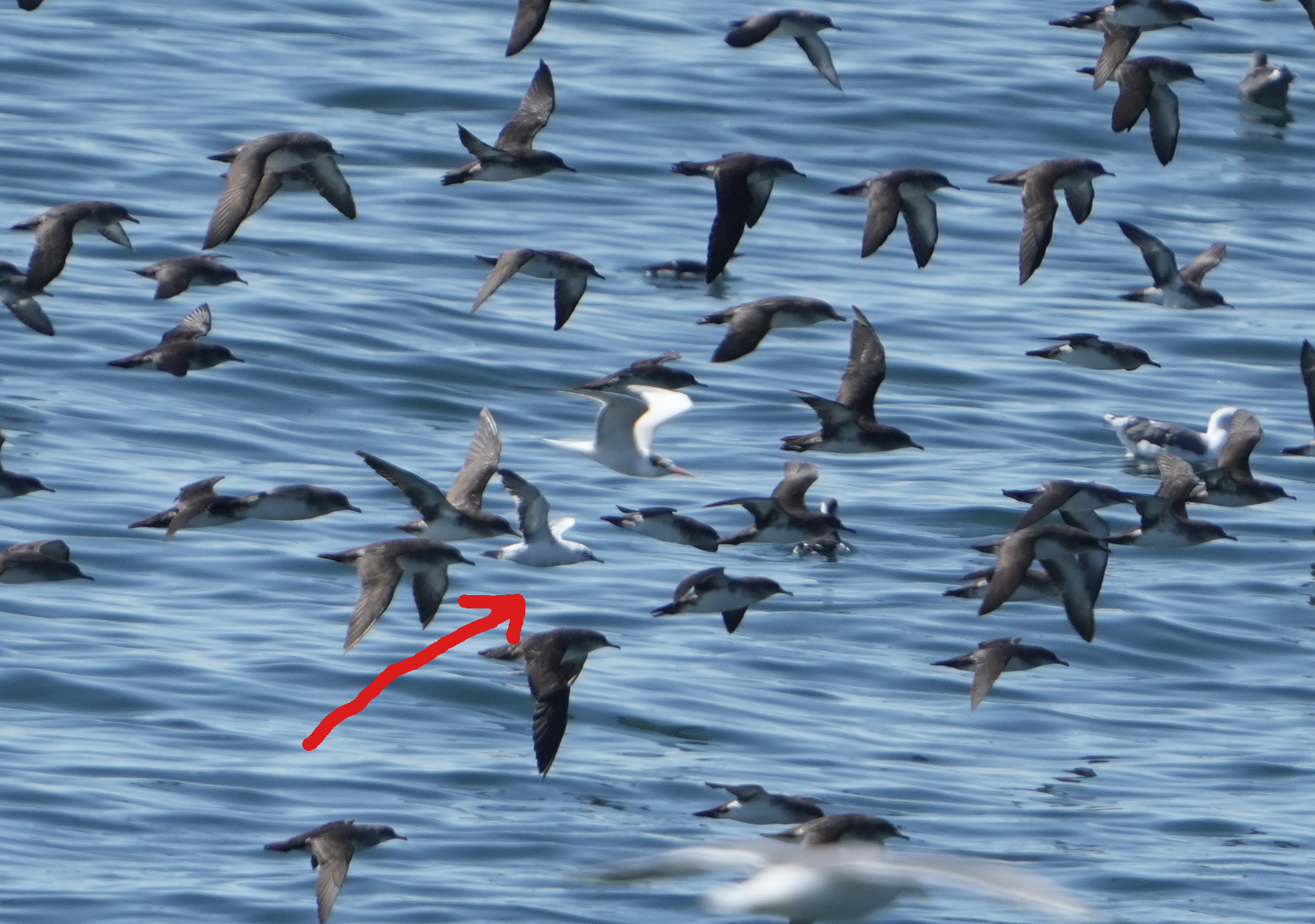
For some reason amelanic, leucistic, piebald…. Whatever you want to call them, Black-vented Shearwaters are frequent. Any time you have a good number to look through, you will find one or more. In my experience it is the species that I have seen which has seemingly the highest proportion of birds with white feathers. The caveat is that some birds you never get to see in numbers, so you really do not know, but of those you do get to see in numbers, this one wins out. The question is why?
Note that while you see this type of thing in Sooty Shearwaters once in a while, the proportion is way, way less.
From: <mbbirds...> <mbbirds...> On Behalf Of Ryan Phillips
Sent: Tuesday, October 6, 2026 10:52 PM
To: Pete Sole <pete...>; MBB <mbbirds...>
Subject: Re: [MBBIRDS] Leucistic Black-vented Shearwater?
On Tue, Oct 6, 2026, 7:46 PM 'Pete Sole' via mbbirds <mbbirds...> <mailto:<mbbirds...> > wrote:
Hi birders,
Reviewing my bird images from the SC lighthouse today, I came across a
photo with what looks like a LEUCISTIC BLACK-VENTED SHEARWATER. Can't
say I've seen one of these before. Here is a crop of the frame in
question, with a red arrow pointing to the interesting bird, flying
below and to the left of the elegant tern:
"Everyone likes birds. What wild creature is more accessible to our eyes
and ears, as close to us and everyone in the world, as universal as a bird?"
- Sir David Attenborough
On Tue, Oct 6, 2026, 7:46 PM 'Pete Sole' via mbbirds <
<mbbirds...> wrote:
> Hi birders,
>
> Reviewing my bird images from the SC lighthouse today, I came across a
> photo with what looks like a LEUCISTIC BLACK-VENTED SHEARWATER. Can't
> say I've seen one of these before. Here is a crop of the frame in
> question, with a red arrow pointing to the interesting bird, flying
> below and to the left of the elegant tern:
>
>
> https://www.lighthousenet.com/photos/birds/documentary/shearwater_black_vented_leucistic_261006a.jpg >
> If somebody has a different opinion as to what this bird might be, or
> can confirm my ID suspicion, it would be great to read.
>
> Interesting birds out there...
>
> Pete Solé
>
>
> --
> You received this message because you are subscribed to the Google Groups
> "mbbirds" group.
> To unsubscribe from this group and stop receiving emails from it, send an
> email to mbbirds+<unsubscribe...>
> To view this discussion visit
> https://groups.google.com/d/msgid/mbbirds/<cec76ab9-9916-4561-beaf-aee3227f5bf3...> > .
>
Reviewing my bird images from the SC lighthouse today, I came across a
photo with what looks like a LEUCISTIC BLACK-VENTED SHEARWATER. Can't
say I've seen one of these before. Here is a crop of the frame in
question, with a red arrow pointing to the interesting bird, flying
below and to the left of the elegant tern:
I am seeing much the same thing being reported here at New Brighton SB.
Sooties, Black-vented, jaegers, gulls, pelicans, cormorants, etc. There are
also six humpback whales, a pod of bottlenose dolphins, two white sharks,
and multiple leopard sharks thrown in the mix. There is a lot happening
nearshore in the bay right now. The hardest part is to figure out where to
look.
Jim
On Tue, Oct 6, 2026, 4:12 PM 'Pete Sole' via mbbirds <
<mbbirds...> wrote:
> Hi birders,
>
> First, big thanks to Ryan, and all of the other birders that have been
> reporting on this amazing event, today (Tuesday Oct. 6, 2026).
>
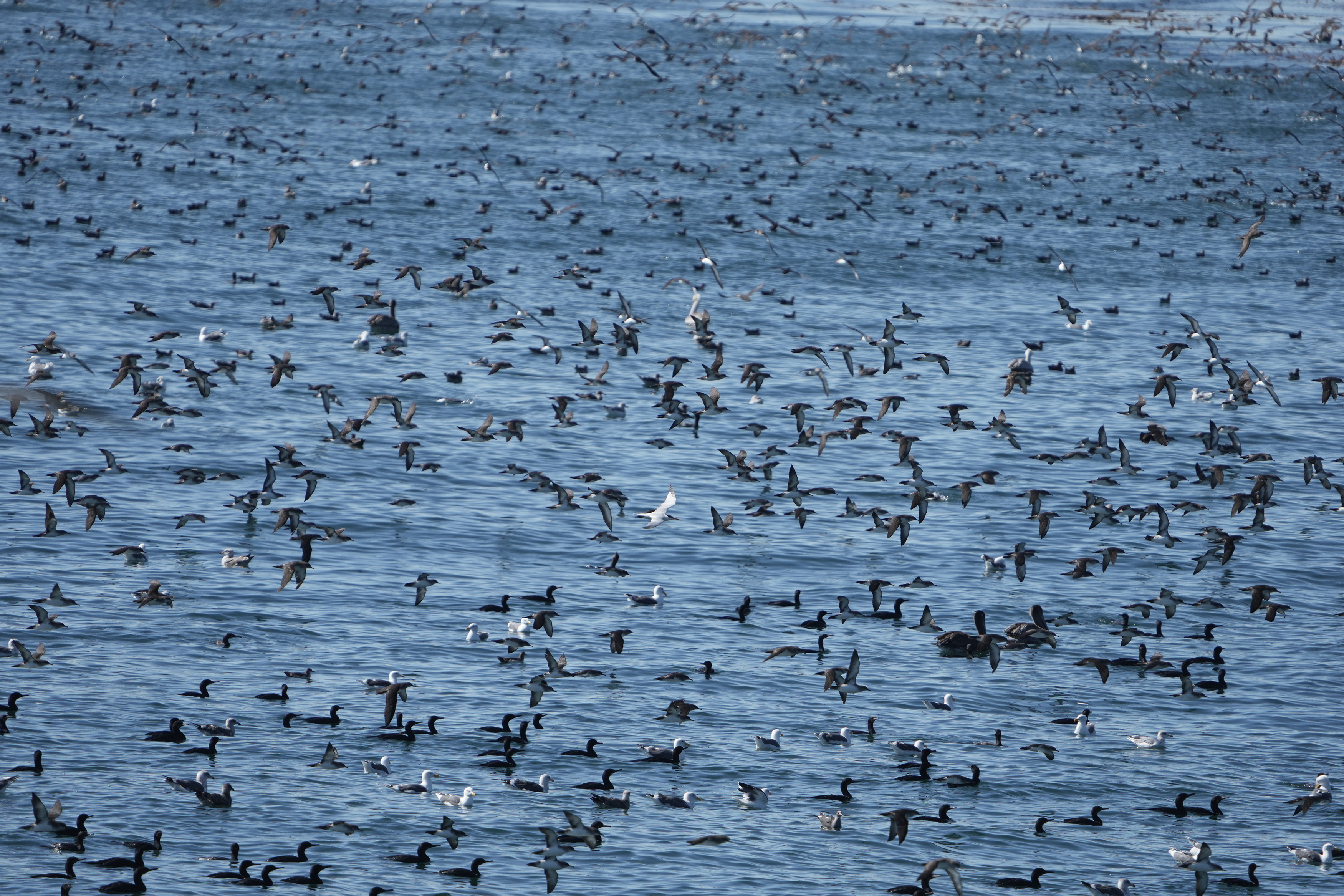
> Around 11am I went over to the SC Lighthouse to catch some of it. Here is
> a large image that gives a very rough sense of what it looked like, when
> looking south from the lighthouse:
>
>
> https://www.lighthousenet.com/photos/birds/documentary/shearwaters_black_vented_and_more_261006b.jpg >
> Just an astonishing number of birds! The majority were Black-vented
> Shearwaters, Brand's Cormorants, Western and Heerman's Gulls, and Brown
> Pelicans. For more detail and photos see the ebird report at:
>
> https://ebird.org/checklist/S399827733 >
> My understanding from another birder, was that the anchovies were washing
> up on the western edge of Its Beach. Unfortunately, I ran out of time
> before I could get to the actual beach to take more photos.
>
> Pete Solé
>
> visiting from Soquel CA
>
>
>
> On 10/6/26 8:57 AM, Ryan Phillips wrote:
>
> Insane feeding Frenzy off Its Beach!!! Black-vented Shearwaters only 100
> feet out!
>
> *Ryan Phillips* ǀ Owner and Guide
>
> Personal and Group Birding Excursions in Northern California and Beyond
>
>
>
> Phone ǀ (831) 234-7324
>
> Email ǀ <norcalbirding...>
>
> Website ǀ *www.norcalbirding.com <http://www.norcalbirding.com/>* >
> Facebook ǀ www.facebook.com/norcalbirding
>
> "Everyone likes birds. What wild creature is more accessible to our eyes
> and ears, as close to us and everyone in the world, as universal as a bird?"
>
> - Sir David Attenborough
>
>
>
>
> --
> You received this message because you are subscribed to the Google Groups
> "mbbirds" group.
> To unsubscribe from this group and stop receiving emails from it, send an
> email to mbbirds+<unsubscribe...>
> To view this discussion visit
> https://groups.google.com/d/msgid/mbbirds/<CAGiyp6V6y6Mt3YHPhY_oAvNZdX_4WrdYS_Bb5N8GHzakjGrNfw...> > <https://groups.google.com/d/msgid/mbbirds/<CAGiyp6V6y6Mt3YHPhY_oAvNZdX_4WrdYS_Bb5N8GHzakjGrNfw...>?utm_medium=email&utm_source=footer> > .
>
>
> --
> You received this message because you are subscribed to the Google Groups
> "mbbirds" group.
> To unsubscribe from this group and stop receiving emails from it, send an
> email to mbbirds+<unsubscribe...>
> To view this discussion visit
> https://groups.google.com/d/msgid/mbbirds/<91c11171-7753-4ec8-a85c-b8db788a1080...> > <https://groups.google.com/d/msgid/mbbirds/<91c11171-7753-4ec8-a85c-b8db788a1080...>?utm_medium=email&utm_source=footer> > .
>
First, big thanks to Ryan, and all of the other birders that have been
reporting on this amazing event, today (Tuesday Oct. 6, 2026).
Around 11am I went over to the SC Lighthouse to catch some of it. Here
is a large image that gives a very rough sense of what it looked like,
when looking south from the lighthouse:
Just an astonishing number of birds! The majority were Black-vented
Shearwaters, Brand's Cormorants, Western and Heerman's Gulls, and Brown
Pelicans. For more detail and photos see the ebird report at:
My understanding from another birder, was that the anchovies were
washing up on the western edge of Its Beach. Unfortunately, I ran out of
time before I could get to the actual beach to take more photos.
Date: 10/6/26 1:10 pm From: 'Yahoo' via mbbirds <mbbirds...> Subject: [MBBIRDS] Hundreds of Cranes
I m just back to Santa Cruz having driven Saturday afternoon and this morning on Sandy Mush Road. Today about 0930 hundreds (I lost count at 250) of Sandhill Cranes in dairy field east of wildlife entrance adjacent to Sandy Mush Road. Flying in as I sat in car. Mid afternoon on Saturday a thousand ibis fed in a field just N of Merced Wildlife entrance. Today at 0900, 200 ibis east of rt 59 along Sandy Mush Road east of the big dairy.
Sent from Yahoo Mail for iPhone
--
You received this message because you are subscribed to the Google Groups "mbbirds" group.
To unsubscribe from this group and stop receiving emails from it, send an email to mbbirds+<unsubscribe...>
To view this discussion visit https://groups.google.com/d/msgid/mbbirds/<417236273.683238.1791317418967...>
Date: 10/3/26 10:59 am From: Nelson Samuels <samnelo...> Subject: [MBBIRDS] Matt McFaul posted pictures from Moss Landing of this Yellow-crowned Night Heron on the Nextdoor app this morning.
Sept 30 Hermit Thrush and Ruby-crowned Kinglet
Oct 1 Fox Sparrow and a Hermit Warbler that we got great looks at our bird bathWe have had several Golden-crowned sparrows for about a weekDown here on The Land in Royal Oaks, CAHappy Birding, Laura and Betty
Date: 9/28/26 5:13 pm From: Ryan Phillips <norcalbirding...> Subject: [MBBIRDS] SC Wharf BV Shearwaters and Jaegers
Lots of action off the end of the Santa Cruz Wharf. Scope needed. Multiple
jaegers (for sure one is Parasitic) chasing Elegant Terns and Black-vented
Shearwaters (at least 300, likely many more) in binocular range but a scope
helps.
*Ryan Phillips* ǀ Owner and Guide
Personal and Group Birding Excursions in Northern California and Beyond
A juvenile male rose-breasted grosbeak visited our yard last week, picking up seed off the ground and sampling the suet. This is a new yard bird for us.
Date: 9/28/26 11:17 am From: Matthew Coale <matthewcoale02...> Subject: [MBBIRDS] Spotted Sandpiper
Hi MBBers I saw what looks like a SPOTTED SANDPIPER at the harbor this morning at 11:00am. It was in fresh water from an inlet at the west side of the harbor near the railroad bridge. Best viewed from the railroad bridge looking west Matthew Coale Santa Cruz
Date: 9/24/26 5:31 pm From: 'Pete Sole' via mbbirds <mbbirds...> Subject: [MBBIRDS] Fox Sparrows at Loma Prieta
Hi birders,
Been meaning to write about the FOX SPARROWS at Loma Prieta for a couple
of days. I went to Loma Prieta on Tuesday Sept. 22nd and, as other
birders noted as well, there were many FOX SPARROWS. I conservatively
reported 7 individuals on my ebird checklist
<https://ebird.org/checklist/S395321875> for the morning, but there were
probably more.
Interestingly, a number of them were of the SLATE-COLORED subspecies,
including an individual that I was able to photograph. (Sadly the photos
are ahem, poor.)
Regardless, SLATE-COLORED FOX SPARROWS may be, a different species from
the SOOTY FOX SPARROW subspecies we more commonly see closer to the
coast. According to Cornell's Birds of the World reference site,
"analyses of mitochondrial DNA (mtDNA) detected significant amounts of
genetic structure, identifying 4 groups of Fox Sparrows corresponding to
those defined by plumage and morphology..". Cornell's site, lists 19
subspecies of Fox Sparrows, grouped into the 4 major groups; SOOTY,
THICK-BILLED, SLATE-COLORED, and RED. ( Source:
https://birdsoftheworld.org/bow/species/foxspa/cur/systematics )
What does this mean in plain English?
What our common reference books and apps mention as four subspecies of
Fox Sparrow, are actually groups of subspecies that may each be, a
separate species; SOOTY, THICK-BILLED, SLATE-COLORED, and RED.
Given the various contact points between the purported subspecies and
hybridization, ornithologists are still debating and collecting data.
Currently, some professional references already treat the four groups as
separate species. For example, the official International Ornithological
Committee (IOC), the predecessor to the International Ornithologists'
Union (IOU), lists the four Fox Sparrow groups as separate species. (To
see the IOC list, see this link:
This is a large searchable spreadsheet that may take time to load, even
on a fast internet connection.)
In any case, imho, it is worth it to try to list and document, the
separate Fox Sparrow subspecies that we can ID in the field. Who knows,
some day your report and photos may count as another species.
Fun birding,
Pete Solé
nerding out on bird speciation and migration in Soquel CA
Last weekend I was on the water guiding two full days of pelagic birding on
Monterey Bay. I am including highlights and links to the trip reports below.
Alvaro's Adventures Trip Report 9/19/26:
<https://ebird.org/tripreport/574413> We faced tough conditions, but made
it out to the canyon systems off Davenport and Año Nuevo. Highlights
included a pair of Craveri's Murrelets, an offshore Red-breasted Nuthatch,
several Parasitic and Pomarine Jaegers, a dozen Red Phalaropes, close looks
at an Arcitc Tern and Sabine's Gull, several Black-vented Shearwaters, and
an incredibly cooperative Guadalupe Fur Seal!
Monterey Seabirds Trip Report 9/20/26:
<https://ebird.org/tripreport/574677> Conditions
were a bit better than the previous day. We made it to similar waters, and
then followed the shelf edge all the way to Moss Landing. Highlights
included two Flesh-footed Shearwaters, a leucistic Sooty Shearwater, brief
looks at a couple of Short-tailed Shearwaters, incredible looks at a
Buller's Shearwater, South Polar Skua, dozens of Black Storm-petrels,
lunge-feeding Humpbacks, and Orcas (CA51s and CA50B)!
Pelagic season is still on with several more trips on Monterey Bay
with Monterey
Seabirds <https://www.montereyseabirds.com/> and a few more trips further
north out of Half Moon Bay and San Francisco with Alvaro's Adventures
<https://www.alvarosadventures.com/pelagic-dates-2026.html>. With this
year's warm water, who knows what might show up. Hope to see you on a boat
soon!
Date: 9/21/26 7:30 pm From: 'Pete Sole' via mbbirds <mbbirds...> Subject: [MBBIRDS] As the world terns...
Hi birders,
Just before lunch, went down to Aptos Creek Mouth for a purportedly
"short" look at the terns on the beach. The hope was to see a parasitic
jaeger for the season. Dipped on the jaeger, (probably too late in the
day), but there were hundreds (700+?) ELEGANT TERNS resting on the
beach. Among the many ELEGANTS, was also a FORSTER'S TERN and a COMMON
TERN. Some images: